December 9, 2025 Bhagyashree Samal
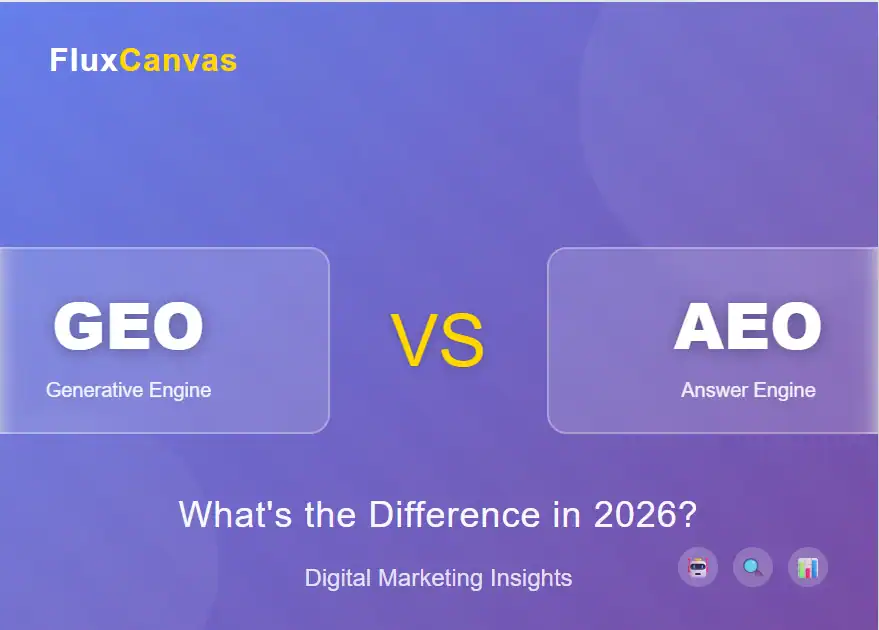
If you’ve been in the digital marketing game for a while, you probably remember when SEO was the only acronym that mattered. Fast forward to today, and we’re talking about GEO and AEO. So, what’s the deal with these new kids on the block?
At FluxCanvas, we’ve been helping businesses navigate these evolving search landscapes, and trust me, understanding the difference between Generative Engine Optimization (GEO) and Answer Engine Optimization (AEO) isn’t just marketing jargon—it’s essential for your brand’s visibility in 2025.
Let’s start with Generative Engine Optimization, or GEO for short. Think about the last time you asked ChatGPT, Claude, or Google’s AI Overview a question. These AI-powered tools don’t just show you links—they actually generate answers by pulling information from across the web.
GEO is all about making sure your content gets picked up, understood, and cited by these AI engines. When someone asks an AI chatbot about digital marketing strategies or web design tips, you want your agency’s expertise to be part of that answer.
Why does GEO matter for your business?
More people are skipping traditional search engines altogether and going straight to AI assistants. According to recent trends, users love the conversational, instant answers they get from generative AI. If your content isn’t optimized for these platforms, you’re basically invisible to a growing chunk of your audience.
Answer Engine Optimization takes a slightly different approach. Remember those featured snippets at the top of Google search results? That’s AEO in action.
AEO focuses on getting your content featured as the direct answer in traditional search engines. It’s about structuring your content so search engines can easily extract the perfect answer to user queries and display it prominently.
When someone Googles “what is digital marketing,” and your agency’s definition appears in that coveted position zero, that’s the result of solid AEO work.
Here’s where things get interesting. While both GEO and AEO aim to increase your visibility, they work in fundamentally different ways:
1. The Technology Behind Them
GEO targets generative AI platforms like ChatGPT, Perplexity AI, and Google’s Gemini. These tools use large language models to create original responses based on their training data and real-time information.
AEO, on the other hand, focuses on traditional search engines—Google, Bing, DuckDuckGo—that pull exact snippets from web pages to display as quick answers.
2. How Your Content Gets Used
This is huge. With GEO, AI engines digest your content and reformulate it into conversational responses. Your exact words might not appear, but your ideas and information do.
With AEO, search engines extract specific sentences or paragraphs directly from your page. You’ll see your actual content displayed in featured snippets, people also ask boxes, and knowledge panels.
3. User Behavior
GEO caters to users who want conversations. They ask follow-up questions, dive deeper into topics, and expect personalized responses.
AEO serves users who want quick facts. They’re looking for fast answers and might click through to your site for more details.
At FluxCanvas, we’ve seen firsthand how these optimization strategies play out for our clients. Let me share a practical example.
Say you run an e-commerce store selling eco-friendly products. With strong AEO, when someone searches “best sustainable cleaning products,” your product list might appear in Google’s featured snippet.
But with GEO, when someone asks an AI chatbot for “environmentally friendly alternatives to traditional cleaners,” the AI might reference your blog content, cite your brand as an authority, and even recommend your products in its response.
Both scenarios drive traffic, but they reach users at different stages of their journey.
You don’t have to choose between GEO and AEO—in fact, you shouldn’t. Here’s how FluxCanvas approaches optimization for both:
For Effective GEO:
Create comprehensive, authoritative content that AI can trust. Use natural language, answer questions thoroughly, and cite credible sources. Structure your content with clear headings and logical flow. AI models love well-organized information they can easily parse and understand.
Build topical authority. Don’t just write one article about digital marketing—create a content hub that covers everything from social media strategies to email marketing and analytics.
For Strong AEO:
Focus on question-based content. Use actual questions as your headings: “How do I improve my website’s conversion rate?” or “What are the benefits of content marketing?”
Keep your answers concise and direct. While you can elaborate later in the article, lead with a clear, quotable answer that search engines can extract.
Use structured data markup. Schema.org markup helps search engines understand your content better and increases your chances of appearing in rich results.
Here’s what we’ve learned from implementing both GEO and AEO strategies for our clients: the fundamentals of great content haven’t changed. You still need to provide value, answer real questions, and establish expertise.
What has changed is how you package and present that information. Your content needs to be simultaneously human-friendly and machine-readable. It should work for someone reading your blog at 2 AM and for an AI scanning millions of pages to generate an answer.
Look, we could debate all day about whether GEO or AEO is more important. But the truth is, your audience is everywhere. Some people still Google everything. Others treat ChatGPT like their personal search assistant. Many switch between both depending on what they need.
Your digital marketing strategy should meet people wherever they are. That means optimizing for traditional search engines, generative AI platforms, and everything in between.
We’re living through a massive shift in how people find information online. At FluxCanvas, we’re not just keeping up with these changes—we’re helping our clients stay ahead of the curve.
Whether you’re a startup looking to establish your online presence or an established brand adapting to new search behaviors, understanding GEO and AEO isn’t optional anymore. It’s the difference between being found and being forgotten.
If you’re feeling overwhelmed by all these changes, you’re not alone. The digital marketing landscape evolves fast, and keeping up while running your business is no small task.
That’s exactly why FluxCanvas exists. We combine cutting-edge optimization techniques with proven digital marketing strategies to help your brand thrive in this new era of search.
Want to know how your current content stacks up for both GEO and AEO? Let’s talk. Our team can audit your website, identify opportunities, and create a customized strategy that gets your business noticed—whether people are searching on Google or asking their favorite AI assistant.
Because at the end of the day, great digital marketing isn’t about chasing every trend. It’s about understanding your audience, providing real value, and making sure people can find you when they need what you offer.