November 22, 2025 Bhagyashree Samal
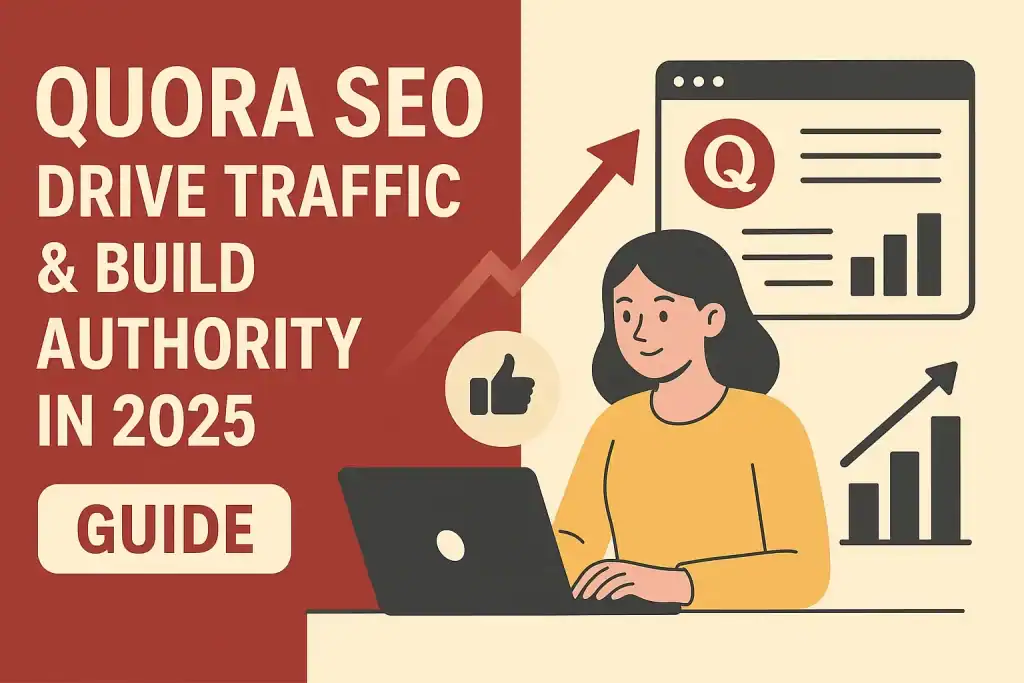
In the crowded digital marketing landscape, businesses constantly search for untapped channels that deliver quality traffic without breaking the bank. While most marketers focus solely on traditional search engines, they’re missing out on one of the internet’s most powerful question-and-answer platforms and quora-seo-drive-traffic-build-authority-in-2025-guide.
With over 400 million monthly active users asking questions on virtually every topic imaginable, Quora has evolved from a simple Q&A site into a legitimate traffic generation powerhouse. More importantly, answers on Quora frequently rank on Google’s first page, making it a dual-threat platform for visibility.
This comprehensive guide will show you exactly how to leverage Quora SEO to drive targeted traffic, establish thought leadership, and build lasting authority in your niche.
Quora SEO refers to the strategic optimization of your Quora profile, answers, and content to rank both within Quora’s internal search and on external search engines like Google. Unlike traditional SEO that can take months to show results, Quora offers a faster path to visibility.
Direct Quora Traffic: Your answers appear to users actively searching for solutions within the platform, delivering highly qualified visitors to your website.
Google Search Visibility: Quora answers frequently dominate Google’s search results, especially for informational queries and long-tail keywords.
Authority Building: Consistent, valuable contributions position you as an expert, building trust that converts readers into customers.
Understanding Quora’s ranking algorithm is essential for maximizing your visibility. The platform uses several key factors to determine which answers appear at the top:
Answer Quality and Length: Comprehensive, well-structured answers with 300+ words typically outperform short responses. Quora rewards depth and thoroughness.
Upvotes and Engagement: Answers that receive upvotes, shares, and comments signal value to the algorithm. Early engagement is particularly crucial.
Credentials and Authority: Your profile credentials, topic expertise badges, and overall reputation influence your answer’s initial visibility.
Relevance to Question: How directly your answer addresses the specific question asked affects ranking. Stay focused on the query.
Recency: Newer answers often get an initial boost, though quality content maintains rankings long-term.
External Clicks: When readers click through to your linked resources, it signals valuable content to Quora.
Your Quora profile serves as your foundation for authority building. A well-optimized profile increases credibility and click-through rates.
Professional Profile Photo: Use a high-quality headshot that builds trust. Profiles with photos receive significantly more views.
Compelling Bio: Write a 150-200 word bio that establishes your expertise while naturally incorporating relevant keywords related to your industry.
Credentials: Add specific credentials related to topics you’ll answer. “Digital Marketing Specialist at [Company]” or “10 Years in Web Design” boost authority.
Topic Following: Follow 20-50 relevant topics in your niche. This helps Quora’s algorithm understand your expertise areas.
Link Placement: Add your website link in the profile description where allowed. Make it contextually relevant rather than promotional.
Effective Quora SEO begins with understanding what your target audience is actually asking. This requires a different approach than traditional keyword research.
Use Quora’s Search Function: Type seed keywords related to your business and explore the suggested questions that appear.
Analyze Question Views: Focus on questions with 10,000+ views that already have proven traffic potential.
Check Google Rankings: Search your target keywords in Google and note which Quora threads appear on page one.
Topic Page Analysis: Visit relevant topic pages to discover trending questions receiving current attention.
Competitor Analysis: See which questions your competitors have answered to identify opportunities.
Long-tail Keywords: “How to optimize website speed for better conversions in 2025” (specific, lower competition)
Short-tail Keywords: “SEO tips,” “content marketing,” “web design” (broader, higher competition)
Question Keywords: “What is,” “how to,” “why does,” “best way to” (naturally fits Q&A format)
Problem-Solution Keywords: “Fix slow website,” “increase blog traffic,” “improve conversion rate”
Writing great Quora answers requires balancing helpfulness with strategic optimization. Follow this proven framework:
Hook Opening: Start with a compelling first sentence that immediately addresses the question. “Yes, you absolutely can drive 10,000+ monthly visitors from Quora—here’s the exact strategy that worked for me.”
Structured Content: Use headers, bullet points, and numbered lists to improve readability. Break long paragraphs into 2-3 sentence chunks.
Keyword Integration: Naturally incorporate your target keywords 3-5 times throughout the answer without keyword stuffing.
Comprehensive Coverage: Aim for 500-1000 words for competitive questions. Thoroughly address all aspects of the query.
Original Insights: Share personal experiences, case studies, or unique perspectives that differentiate your answer from others.
Visual Elements: Add relevant images, screenshots, or infographics when they enhance understanding.
Strategic Linking: Include 1-2 contextually relevant links to your website content that genuinely helps the reader. Never be overly promotional.
Clear Call-to-Action: End with a soft CTA like “For a deeper dive into this strategy, check out our complete guide [here].”
Once you’ve mastered the basics, these advanced tactics will amplify your results:
Answer questions within the first 24-48 hours of posting when possible. Early answers receive more initial exposure, and early upvotes compound over time.
Share your best answers with colleagues or in relevant communities to generate initial upvotes. This social proof triggers Quora’s algorithm to show your answer to more users.
Revisit your top-performing answers quarterly to update statistics, add new insights, and improve formatting. Updated content signals freshness to both Quora and Google.
Join and actively contribute to relevant Quora Spaces. These community areas provide additional visibility and networking opportunities.
Partner with other Quora contributors by referencing their insights (with attribution). This builds relationships and increases cross-exposure.
Measuring results is crucial for refining your strategy. Focus on these key metrics:
Answer Views: Track which answers generate the most visibility over time.
Upvotes and Shares: Higher engagement indicates content resonance and algorithm favorability.
Click-Through Rate: Monitor how many readers click your links using UTM parameters in URLs.
Google Rankings: Check if your answers rank on Google for target keywords using incognito search.
Referral Traffic: Use Google Analytics to track visitors coming from Quora and their behavior on your site.
Conversion Rate: Ultimately, measure how many Quora visitors convert into leads or customers.
Even experienced marketers make these errors that sabotage their Quora efforts:
Over-Promotion: Constantly pushing your products or services triggers downvotes and community backlash. Focus 90% on value, 10% on promotion.
Thin Content: Short, generic answers rarely rank or drive traffic. Invest time in comprehensive responses.
Ignoring Engagement: Never responding to comments on your answers misses relationship-building opportunities.
Inconsistent Activity: Sporadic answering doesn’t build authority. Commit to 3-5 quality answers weekly.
Keyword Stuffing: Unnatural keyword repetition hurts readability and credibility.
Copying Content: Reposting content from your blog word-for-word violates Quora’s policies and provides poor user experience.
Quora works best as part of a holistic content marketing approach:
Blog Post Promotion: After publishing comprehensive blog posts, answer related Quora questions with excerpts and link to the full article.
Content Gap Identification: Use popular Quora questions to identify topics your audience cares about but you haven’t covered on your blog.
Repurposing Opportunities: Transform high-performing Quora answers into blog posts, social media content, or email newsletter material.
Lead Magnet Distribution: Offer relevant downloadable resources in your answers to capture leads.
As search engines increasingly prioritize helpful, experience-driven content, platforms like Quora will continue gaining prominence in search results. Google’s helpful content update specifically favors the type of authentic, user-generated content that thrives on Quora.
Forward-thinking marketers should invest in building their Quora presence now while competition remains relatively low compared to traditional search optimization.
Quora SEO represents one of the most underutilized traffic generation strategies available to businesses today. By consistently providing valuable answers, optimizing for both Quora’s internal algorithm and Google search, and building genuine authority in your niche, you can tap into a steady stream of highly qualified traffic.
The key is patience and consistency. Unlike paid advertising that stops when the budget runs out, your Quora answers continue generating traffic and building authority for months or years after publication.
Start today by identifying 10 high-value questions in your niche and committing to providing the most comprehensive, helpful answers on the platform. The compounding returns will surprise you.
Ready to take your content marketing to the next level? FluxCanvas helps businesses create stunning, conversion-optimized content that drives real results. Whether you’re building authority on Quora or across other digital channels, our platform gives you the tools to stand out and convert visitors into customers.
You can see initial traffic within 24-48 hours if you answer active questions. However, building significant authority and consistent traffic typically takes 2-3 months of regular, quality contributions. High-ranking Google positions for Quora answers may develop within 4-8 weeks.
Quality trumps quantity. Aim for 3-5 comprehensive, well-researched answers per week rather than posting numerous thin responses. Focus on questions with high view counts and strategic relevance to your business.
Yes, but they must be contextually relevant and genuinely helpful to the reader. Limit yourself to 1-2 links per answer, and ensure they provide additional value beyond what’s in your response. Overly promotional linking can result in answer collapse or account restrictions.
No, Quora+ is an ad-free reading experience for users and doesn’t provide any SEO or visibility advantages for content creators. All ranking factors apply equally to free accounts.
Respond professionally and constructively to legitimate criticism. If comments are abusive or spam, use Quora’s reporting tools. Engaging thoughtfully with critics can actually boost your credibility and engagement signals.
Absolutely. Quora answers frequently appear in Google’s top 10 results, especially for informational and how-to queries. Optimizing your answers with proper keywords, comprehensive content, and strong engagement increases ranking probability.
Both strategies have merit. New questions offer first-mover advantage and initial algorithmic boost. Old questions with high view counts provide established traffic but more competition. Ideally, mix both approaches in your strategy.
Provide genuinely helpful, comprehensive content with clear formatting. Answer questions early when possible. Add visual elements. Share your answer through social channels to generate initial engagement. Engage with comments to boost visibility.
Both. They complement each other perfectly. Quora provides faster results and direct audience engagement, while blog SEO builds long-term owned assets. Use Quora to drive traffic to your blog content for maximum impact.
Most industries can benefit, especially B2B services, technology, finance, health, education, and professional services. The key is identifying whether your target audience actively asks questions related to your offerings on the platform.