May 19, 2026 Bhagyashree Samal
The way people search online is changing faster than ever.
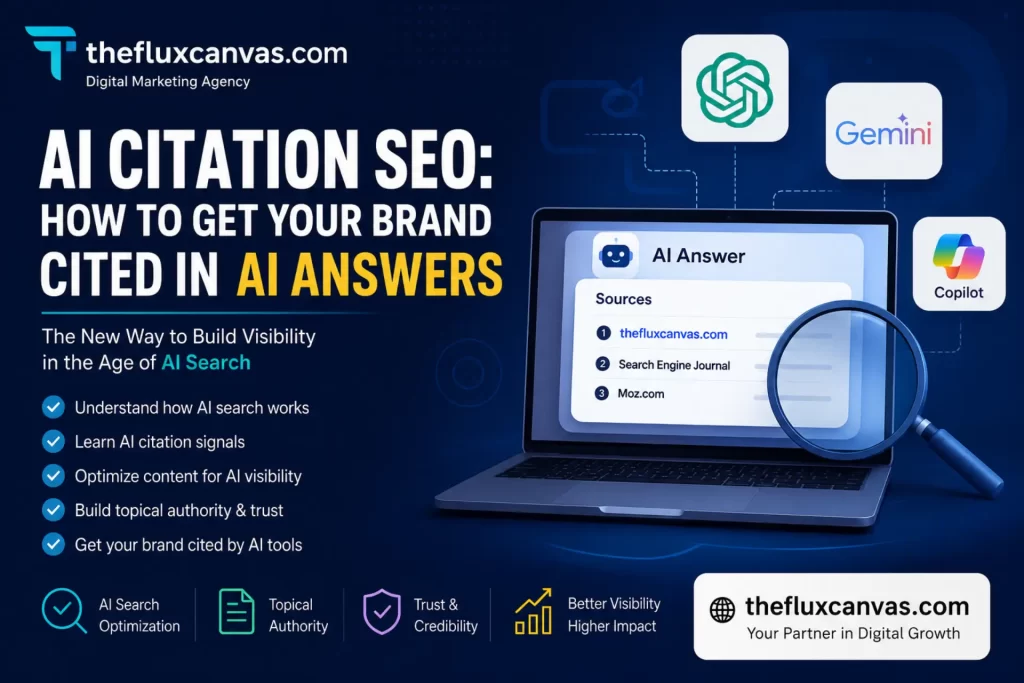
For years, businesses focused on ranking websites on Google’s first page. Traditional SEO revolved around keywords, backlinks, and click-through rates. But now, AI-powered platforms like ChatGPT, Google Gemini, Microsoft Copilot, and Perplexity are transforming how users discover information.
Instead of browsing multiple websites, users are now asking AI tools direct questions and receiving summarized answers instantly.
This shift has introduced a new digital marketing challenge:
That is where AI Citation SEO comes in.
In this guide, we will break down how AI search works, what AI citation signals matter most, and how businesses can optimize their content strategy to improve visibility in AI-generated answers.
AI Citation SEO is the process of optimizing your content so that AI-powered search systems reference, mention, or cite your website while generating answers.
Unlike traditional search engines that provide users with a list of links, AI search engines summarize information from multiple sources into a single response.
For example, when a user asks:
AI systems collect information from trusted websites and generate a concise answer.
Only a limited number of websites are selected as trusted references.
If your brand gets cited, your authority and visibility increase significantly.
This is why AI Search Optimization is quickly becoming one of the most important areas in digital marketing.
Traditional SEO focused mainly on rankings.
But AI-powered search is focused on:
Modern AI systems do not simply scan keywords.
They evaluate whether your content demonstrates expertise, trustworthiness, and relevance.
This means businesses must evolve beyond outdated keyword stuffing strategies.
Today, brands need:
Businesses investing in advanced SEO services for businesses are already adapting to this change.
To understand AI Citation SEO, you first need to understand how AI retrieval works.
AI-powered systems use Large Language Models (LLMs) combined with retrieval systems.
The process usually looks like this:
Example:
“What are the best strategies for AI Search Optimization?”
The system scans multiple web pages, trusted domains, and authoritative sources.
The AI checks:
The AI summarizes information and sometimes cites the original sources.
This means your content is no longer competing only for rankings.
It is competing for trust.
Many marketers still believe backlinks alone are enough.
However, AI systems evaluate multiple layers of content quality.
Here are the most important AI citation signals:
AI platforms prefer websites that deeply cover a topic.
Instead of publishing random blog posts, brands should build content clusters around specific subjects.
For example, if your agency focuses on digital marketing, your content should include:
The more comprehensive your content ecosystem becomes, the more authority your website gains.
AI systems prefer clean, organized, and readable content.
Best practices include:
Structured content helps AI systems extract information more efficiently.
AI tools evaluate whether your website appears credible.
Important trust signals include:
Building trust is essential for long-term AI visibility.
Modern AI models understand context, not just exact-match keywords.
Instead of repeating the same phrase unnaturally, focus on related concepts and semantic depth.
For example, content about AI Citation SEO should naturally include:
This improves contextual understanding.
Businesses that adapt early will gain a major advantage.
Here are practical strategies to improve AI citation potential.
Instead of writing isolated articles, build interconnected content around one core topic.
Example cluster:
Main Topic:
Supporting Articles:
This strengthens topical authority.
AI systems frequently pull information from direct question-and-answer content.
Include FAQs such as:
These sections improve retrieval opportunities.
AI tools value unique perspectives.
Avoid rewriting generic content already available online.
Instead, publish:
Original content increases trust and authority.
Complex writing often reduces engagement.
Keep your content:
This improves both user experience and AI extraction.
Internal linking helps search engines understand topic relationships.
For example:
| Traditional SEO | AI Citation SEO |
|---|---|
| Focuses on rankings | Focuses on citations |
| Keyword-driven | Context-driven |
| Depends heavily on backlinks | Depends on authority and trust |
| Click-through focused | Visibility focused |
| Search result competition | AI retrieval competition |
Both strategies are still important.
However, the future of search is becoming increasingly AI-driven.
AI-generated search experiences are expanding rapidly.
Platforms like ChatGPT, Gemini, and AI Overviews are changing how users interact with information.
Many users no longer click multiple links.
They simply trust the AI-generated answer.
This means brands that fail to optimize for AI visibility may lose organic traffic over time.
Businesses that adapt early can build long-term authority.
Agencies offering digital marketing solutions must now include AI Search Optimization as part of their growth strategy.
AI Citation SEO is the process of optimizing content so AI platforms like ChatGPT and Gemini reference your website in generated answers.
GEO stands for Generative Engine Optimization. It focuses on optimizing content for AI-powered search engines.
No. Traditional SEO is still important, but AI Search Optimization is becoming an essential extension of modern SEO strategies.
Businesses can improve AI visibility by building topical authority, publishing high-quality content, using structured formatting, and improving trust signals.